Remote Wreckers

David Barnes reports on the growing popularity of remote controlled demolition robots amongst diamond cutting specialists and demolition contractors across the UK 

Controlled Demolition involves the separation and removal of specific sections of a building's structure. These sections are usually isolated from the rest of the building by diamond-tipped saws and cutters. Traditionally, the condemned segments are then demolished using hand held power tools such as concrete crushers and pneumatic drills. This labour-intensive demolition technique has been the subject of increasingly stringent Health and Safety vibration legislation. Commercial pressure to make this process faster, cleaner and more accurate is growing too. As a result, deconstruction specialists are frequently employing remote controlled robots to undertake this highly regulated and demanding process.

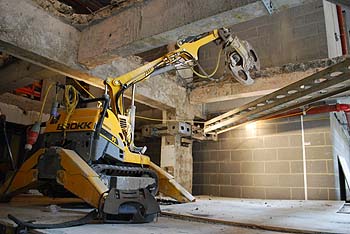
Swedish company Brokk is the largest manufacturer of these unusual machines. Their demolition robots are much more than just remote controlled mini diggers. With a three-part boom and swing attachment they offer extreme dexterity allowing work to be undertaken in the tightest of spaces. They boast a hydraulic system that runs on a low flow/high pressure principle giving them enormous strength relative to their size. The robots' electric motors mean there are no emissions on site and noise pollution is minimal. They are operated remotely via a cable or digital signal ensuring hand and arm vibrations are a thing of the past. Operatives can choose where they stand relative to the machine, thus affording them a safe position, often with excellent visibility of the works.

Brokk controlled demolition machine crushing overhead concrete

Brokk controlled demolition machine crushing concrete

       Brokk remote demoliton machine crushing concrete.

Purchasing and operating these machines is not for the financially faint-hearted. "Expect to pay three times the purchase price of an equivalent sized standard excavator and roughly twice as much to run it", warns Mark. Despite such high costs, the company is implementing a 3 year fleet renewal policy, taking advantage of the strong residual prices Brokks achieve. "There is a much higher demand for used machines now as more companies are entering this market and as a result we can get a better return on some of our older models", says Mark.

When it comes to the Brokk brand itself Castle and Pryor are very satisfied owner-operators. "We did have another manufacturer lend us a machine for a while but it couldn't touch the Brokk for durability or performance", recalls Mark. Such is the impressive nature of the machines Mark is confident they are more productive than larger conventional excavators. "With a breaker fitted, the large 330 can give an 18 tonne excavator a run for its money".

The machines are all fitted with quick-hitch as standard and can operate an array of Brokk attachments, including buckets, concrete crushers, steel shears and breakers. Both the breakers and shears are manufactured by Atlas Copco with the breakers offering between 390 and 1920 blows per minute and a hitting force of up to 1250 lbs/foot. The concrete crushers are made by the German company Darda and can exert a force of between 22 and 52 tonnes depending on which Brokk model is being used. For really unusual jobs Brokk can actually design and manufacture custom-made attachments.

There appear to be few negatives to running Brokks with the only areas of frustration being complex electronics and no independent power source, such as a battery or dog generator for the machine when out of reach of a three-phase electrical socket.

The training and accreditation required to operate the Brokks is a two stage affair. An initial 'Certificate of Operator Competency' is issued after undertaking a Brokk UK training course. Typically lasting a day, the course is usually run when Brokk delivers a new machine to a client. Because most of these machines go straight to work this means the course is undertaken in-situ on the client's site. Courses also run at Brokk's UK headquarters in Cumbria. The training covers how to operate the machine, dealing with any unusual operator or machine generated messages, and understanding the health and safety issues associated with the machine. Trainees at Castle & Pryor undertake this course and then work alongside experienced operators within the company developing their skills and building experience. Once they are considered competent by the company's in-house assessors, a CITB Verifier is called in to examine the trainee and issue a CSCS NVQ Level 2 Card. Castle & Pryor are rightly proud of their extensive in-house training program, as Marc Pryor says, "For us, training is the key and whilst expensive, it's definitely worth it".

Brokk machine breaking concrete steps


Castle & Pryor is probably the most experienced operator of Brokk electrically-powered remote-controlled excavators in the UK.Brokk robotic demolition machine with breaker
Earthmovers visited one of the UK's most experienced operators of Brokk demolition robots, Castle & Pryor. Founded in 1992, the Hampshire-based company was amongst the first diamond cutting specialists to realize an application for these unusual machines in the UK. Brokk had originally developed their robots to assist with the reconditioning of cement kilns in Northern Europe. However, Castle & Pryor, along with a handful of other companies, began purchasing Brokks in order to undertake limited demolition in confined areas. Since then the company has not looked back working all over the UK and even as far afield as Sudan. The company normally operates as a sub-contractor for large construction and civil engineering groups, however demand for their Brokk machines is so high that they also hire them to other diamond cutting and drilling specialists. "We started a hire company in a different name to allow our competitors the facility to hire-in machines", states co-founder Mark Castle, "We've had to re-badge our hire machines so they don't act as adverts for Castle & Pryor while working on competitors jobs".

There are 16 Brokk machines in the Castle and Pryor fleet encompassing all 4 models, the smallest of which is the 475kg Brokk 50 measuring just 59cm wide. The Brokk 90 is double the baby Brokk's weight and is the most popular machine with UK operators representing the best combination of size and power. Its compact dimensions allow it to be carried in a passenger lift ensuring it can undertake localized work on any floor of a building or, if required, 'drop' the entire structure from the top down. The 180 model weighs 1900kg and has adjustable track width and a telescopic arm.
The heaviest and most powerful machine is the 4400kg Brokk 330 which Mark describes as the "Mike Tyson" of his fleet. Unlike it's smaller siblings, the giant Brokk often sports steel tracks as oppose to the more common rubber variant. Living up to its nickname, it is deployed on extensive, high volume demolition projects.

Brokk controlled demolition crushing concrete platform

The Brokk has an electric motor driving its internal hydraulics, resulting in no emissions and obviously, being pedestrian controlled, no vibrations.


Brokks usually come with Atlas Copco breakers, offering between 390 and 1920 blows per minute and a hit force of up to 1250 lb.ft.

The impressive nature of Castle & Pryors' machines coupled with this pragmatic and sustainable approach to training recently paid dividend when one of the company's Brokk 50 machines was utilized by building contractor HBG Ltd. Deployed to a site on Bond Street, Central London, the machine worked in extremely close confines and often under hazardous conditions. Equipped with a 55kg breaker, the baby Brokk smashed deep holes in the concrete casings of steel joists. This in turn allowed structural engineers to inspect the steel joists and their concrete surroundings. The machine was able to deftly switch attachments and, using a 0.4 cu ft bucket, clear away the remaining debris. Throughout the contract the Brokk was able to operate remotely in vulnerable areas of the building's structure. The drilling was not time-limited by the HSE regulations which would have been applicable if hand-held equipment had been utilized. The entire process was expeditious and delivered a successful outcome impressing all those involved.

Through their durability and dexterity Brokk remote controlled robots are gradually winning the admiration and respect of all those involved in controlled demolition. With companies like Castle & Pryor operating them safely and reliably on an ever-increasing number of applications there is no doubt they are set to become an increasingly common feature on the UK's building and demolition sites.

                                             - End -  

Brokk breaking concrete steps